
Health Care Law Blog
 Last Friday, the U.S. Department of Health & Human Services ("DHHS") extended important deadlines related to those states desiring to establish State-Based Insurance Exchanges or State Partnership Exchanges for 2014. Specifically, Kathleen Sebelius, Secretary of DHHS, advised governors that DHHS had extended certain deadlines related to the submission of Declaration Letters and Blueprints, stating that DHHS is committed to providing states with flexibility for building a marketplace that meet each state's needs.
As President Obama moves into his second term, health care reform moves forward with him. Wholesale repeal of the Patient Protection and Affordable Care Act (PPACA) now seems highly unlikely. With the majority of the PPACA provisions slated to go into effect in 2014, employers need to be ready.
Foster Swift has developed guides to aid employers with their preparation efforts. Click the links below to download these guides.
|
EMPLOYER & INDIVIDUAL
|
PPACA PROVISION
|
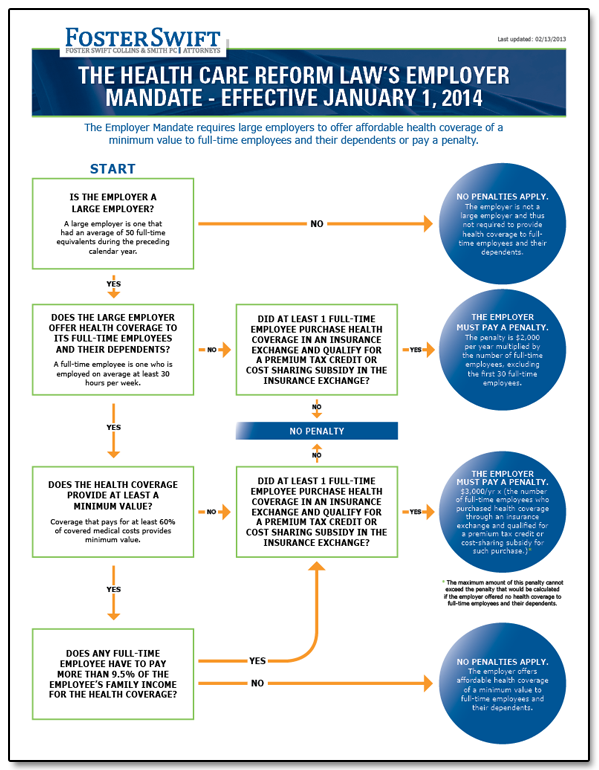
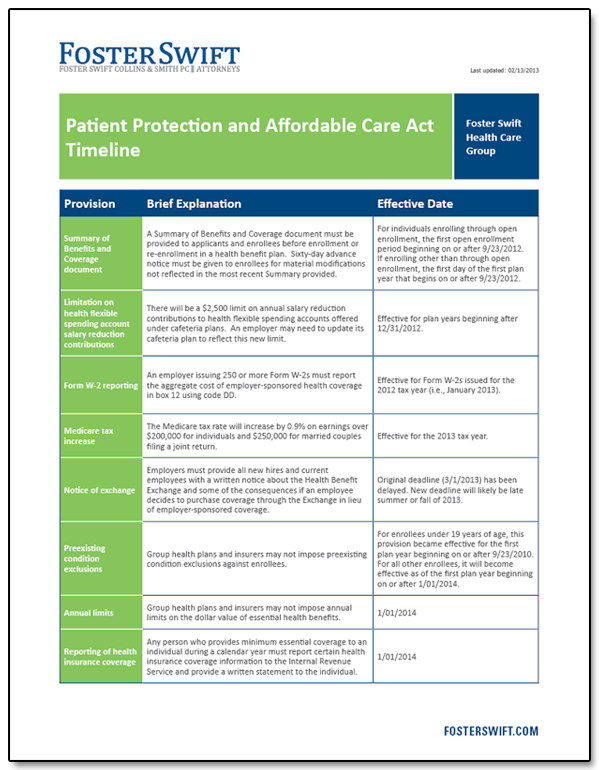
Documents updated 07-12-2013
If you have any questions regarding health care reform, please contact a member of the Foster Swift Health Care Law Group.
On October 11, 2012, the Lansing Regional Chamber of Commerce hosted its annual Healthcare Forum. A half-day event, the Healthcare Forum brings together mid-Michigan leaders in the health care industry to provide updates on the latest issues. This year’s forum, titled “Countdown to 2014 – The Tools to Conform to Healthcare Reform,” drew nearly 100 attendees and featured topics including:
 Curiously, traditional registered nurses ("RNs"), excepting Canadian and Mexican RNs under NAFTA, lack a general temporary visa category to work in the United States. While there are favorable provisions for an RN to obtain permanent resident status (a “Green Card”) based upon employment, the lengthy eligibility wait time for the permanent visa category limits the practical usefulness of these provisions in many cases. Currently, temporary visa options for nurses are limited to the following.
 At the end of August, Governor Rick Snyder announced that Michigan will be pursuing a federal-state partnership for its health insurance exchange. Health insurance exchanges are a requirement of the federal Health Care Reform law. Health insurance exchanges are designed to facilitate the purchase of health insurance by consumers through an online, cost-competitive forum. Each state has the option to: (1) operate its own health insurance exchange; (2) partner with the federal government; or (3) allow the federal government to manage its health insurance exchange.
Foster Swift lawyers were well represented at the Annual Meeting of the State Bar of Michigan's Health Care Law Section held on September 19th. Gilbert Frimet, Gary McRay, Jennifer Kildea Dewane, and Nicole Stratton, members of Foster Swift Health Care Law Practice Group, all traveled to Detroit to attend the meeting.
 With the United States Supreme Court having ruled that nearly all of the provisions in the Patient Protection and Affordable Care Act (“PPACA”) are constitutional, employers are legally obligated to comply with PPACA's requirements. One such requirement of particular interest to employers is the employee health insurance exchange notice requirement.
 The Board of Medicine and the Board of Osteopathic Medicine have proposed amendments to the administrative rules governing the delegation of prescribing authority to physician assistants. Under the existing rules, a physician may only delegate to physician assistants the authority to prescribe controlled substances that are listed in the Federal Drug and Enforcement Administration’s (“DEA’s”) Schedules 3 to 5. The proposed amendments would eliminate that limitation and allow physicians to authorize physician assistants to prescribe Schedule 2 controlled substances.
 Governor Rick Snyder in a press conference this morning proposed a total overhaul of Blue Cross Blue Shield of Michigan ("BCBSM"). Governor Snyder's proposal would:
- covert BCBSM to a non-profit mutual company;
- end its tax exemption; and
- remove Attorney General review of requested rates.
In essence, Michigan would treat BCBSM as it would any other health insurer as BCBSM would be regulated by the Insurance Code. While this proposal may seem drastic, it is not surprising given recent regulation orders by the Office of Financial and Insurance Regulation ("OFIR") curtailing BCBSM's use of most favored nation clauses ("MFN Clauses") and rejecting the low rates that it charges to hospitals and other providers.
On August 31, 2012, a federal district court ruled that the Michigan Health Insurance Claims Assessment Act is not preempted by the federal Employee Retirement Income Security Act. The act imposes a 1% tax on paid health insurance claims for services rendered in Michigan to residents of Michigan. The tax is assessed against commercial insurers, HMOs, nonprofit health and dental corporations, Medicaid managed care organizations, specialty prepaid health plans, third-party administrators, and group health plan sponsors. The act, which took effect on January 1, 2012 and expires on December 31, 2013, authorizes the state to collect up to $400 million in revenues each year, which are used to fund the Michigan state share of the Medicaid program. When combined with the federal multiplier, the tax will generate $2.4 billion in funding for Michigan’s Medicaid program.
